
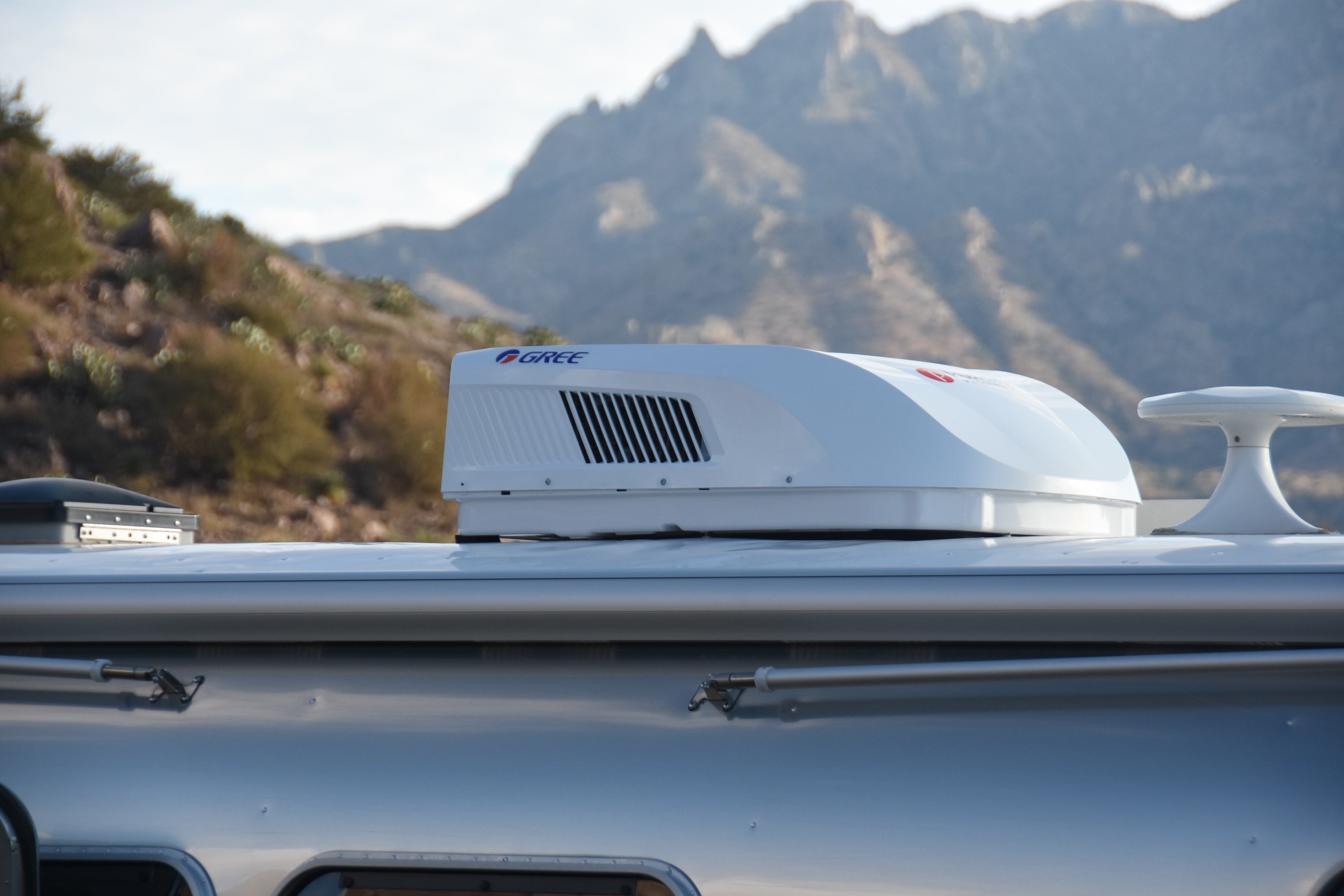
What are the two most common complaints about RV air conditioners?
- They're noisy–even the ducted ones.
- They use a lot of power– so if you have two of them on the roof, you need a 50-amp power connection.
It doesn't have to be like this. RV air conditioners are getting better and in fact, the technology exists today to make them nearly whisper-quiet, and run on as little as half the electricity.
Imagine what that could mean:
First, you wouldn't have to raise your voice, or crank up the volume on whatever you might be listening to, every time the air conditioner cycled on. The sound of the machine starting up wouldn't wake you up at night.
Second, it could be possible to run two air conditioners with a 30-amp power connection. That means no more "anaconda" power cord that is heavy, expensive, and stiff in cold temperatures. It also means you could safely run a single air conditioner on any available plug, even a standard household 15-amp outlet!
So why don't we have these miracle devices? The answer is mostly that they haven't commercially available in the RV market until recently, and of course cost is always a factor. Also, most RV owners don't know that there's a better product available, so they don't ask for it.
That's changing. Some manufacturers are beginning to see an opportunity in offering a better mousetrap. It turns out that making a quieter, more efficient air conditioner isn't really difficult, and lately it isn't even much more expensive.

Who's in the market?
The primary examples are brands you may not have heard of before: Houghton, Gree, Tosot, and Furrion. Don't worry about that, they're all well-established manufacturers.
Gree is the world's largest manufacturer of air conditioners, but has only recently entered the North American market for RVs. Gree has an established partnership with Premier Products, in the form of the Eco-Cool 15K BTU rooftop air conditioner. We've been testing a Gree Eco-Cool on our Airstream for the last six months.
Tosot is a brand of Gree, sold under a different name and utilizing a different design from the Gree Eco-Cool. From the specs, the Tosot isn't quite as energy-efficient, but it is still very quiet.
Houghton is an Australian brand that is distributed in the US by RecPro. You may recognize Furrion, since it is a Lippert brand and Furrion products appear in several places on an Airstream. Their Chill Cube is being tested by our friends at Stressless Camping, and it has been performing well.
There are others coming up, too. Eberspächer is a German company that doesn't really have much of a US presence at the moment, but they're starting to enter the market, with their Breezonic model being installed on some Encore motorhomes. Truma is also offering their Aventa model for trailers and motorhomes.
While some major brands have models that claim additional efficiency or quietness, so far the only one I've seen that might come close is the GE Profile (installed on Airstream Trade Wind, and 2026 models across the Airstream line) which reputedly runs at around 1200 watts. It's not as quiet as the Gree, Furrion or Houghton, and it's hard to be sure about real-world power draw since it can vary substantially depending on atmospheric conditions.
How do they do it?
There's no single "trick" to building a better RV AC, it's more a matter of many improvements working together. Especially:
- Better air handling: careful fan design and balancing, and attention to air flow
- More efficient compressors and heat exchangers
Most of the models mentioned above have variable-speed compressors. This type of compressor is unlike what's in a typical RV air conditioner. Instead of two modes, ON and OFF, the variable speed compressors can adjust to changing temperature needs, which saves power.
Some also have fans that are always on, instead of cycling on and off. This is the feature that seems to cause the most consternation among potential buyers, since they think it means constant noise. In fact, our testing (and the experience of many others) showed us that you usually can't hear the fan running when it is at its lowest level. At most, it's a bit of white noise, and not objectionable at all.
How efficient and quiet are they?
The manufacturers claim an overall savings of 30-40%, and our real-world testing seems to bear that out. The Gree Eco-Cool is typical, pulling a maximum of about 1300 watts on a 90° day with 90% humidity—about the worst-case scenario. We also see about 1300 watts draw in dry desert conditions when the interior is hot from a day of towing in the sun.
The real savings come later. Once the interior is cooled down, the Eco-Cool can step down to draw as little as 800 watts while maintaining the temperature inside. When the compressor isn't needed, the power draw drops to about 70 watts. The Dometic Penguin II that it replaced would draw 1500-1600 watts anytime it cycled on, so the difference is very significant.
(In the image below, our Sorein Power Station is powering a Dometic Penguin II in hot conditions. The power station is outputting 1666 watts to power the AC plus other background loads in the RV, while gaining 266 watts from solar at the same time.)

Most of these air conditioners are advertised as being capable of running from a single 2,000 watt generator, although a soft start module is usually still recommended. They'll put less demand on your generator and consume less gas. Any of them can also be run from a Sorein Power Station, for a longer time because of the low energy usage.
As for noise, it's very hard to objectively compare the units. Manufacturer ratings of loudness (measured in decibels, db) are not consistent, and many don't offer a noise rating at all. But all of these new models are much quieter than the air conditioners they're replacing.
What about the cost?
For the purpose of this comparison, I looked only at RV air conditioners capable of cooling at 13.5K -18K BTUs, which is similar to what's installed in most travel trailers and motorhomes. I found that while there's a premium for a quiet and efficient model, most of them were available at around $1300-1550 (2025 prices), and discounts are often available. In the end, they seem to run about 20-30% more than a standard rooftop air conditioner.
Should you upgrade?
At this point I would consider an upgrade to one of the brands above, if any of these apply to you:
- your rooftop AC is nearing replacement or has failed
- you boondock a lot, and want to run your air from a generator or power station
- you routinely need to plug into a 15-amp (household) outlet to run your air conditioner
- you really hate the noise of your current air conditioner
- you don't have ducted air (more on that below)
Can you upgrade?
Here's the real problem for many RV owners, especially Airstream owners: upgrading can require compromises. For most people, it would be a good idea to consult a professional installer.
1. New thermostat. You will probably find that the air conditioner cannot interface with the existing wall thermostat. This is the case for Gree, Tosot, Houghton, Eberspächer, and Truma, at least. Instead, you'll get either a dedicated wall thermostat for the air conditioner, a remote control, or ceiling-mounted controls on the air conditioner itself.

2. Control board/interface incompatibility. Dometic commonly installed a control board inside the air conditioner, which is the main interface for the thermostat, furnace, second air conditioner (if equipped), and other optional accessories. Without this control board, those appliances won't work.
Some installers are working around this by simply hard-wiring the furnace to a mechanical thermostat. This precludes the option of using a Micro-Air thermostat upgrade later.
We didn't want to lose the functions of the Micro-Air thermostat. Gree didn't offer any sort of interface module to solve this problem, so to work around it, we pulled the control board out of the Dometic Penguin II that we were replacing, and put it in a padded envelope inside the ceiling, still attached to the relevant wires. This allows the furnace to continue to be controlled by the Micro-Air thermostat (and we can keep the ability to remotely monitor the temperature inside via the Micro-Air app), while the Gree is controlled by its own remote.
The wall thermostat showed an error message until we stripped the exterior temp sensor from the Dometic and connected that to the control board, too.

3. Ducted installations can be a major problem on some Airstreams. While some of these units are technically made for either ducted or ductless installation, we discovered that the Airstream "Quietstream" ducted air for our 2020 Globetrotter had a mounting bolt pattern on the roof which wasn't compatible with the Gree's bolt pattern. On a Quietstream-equipped Airstream, you can't change the position of the bolt holes.
It was a long and difficult day when we discovered this. Suffice to say, some complicated fabrication was required, which I would not recommend to the average DIYer or even most professional installers. The US distributors are aware of these problems and may later introduce kits that reduce the compatibility issues.

4. Check the interior ceiling before buying. For a ductless installation, you need to carefully evaluate the interior ceiling space. The "ceiling assembly" (air intake/return, pictured at right) may not be the same shape and size as the one you're replacing, so measure carefully to be sure there's no obstacle in the way like a curtain track, light, smoke detector, etc.
5. No condensate drain. None of these replacement air conditioners can utilize the condensate drain that's installed in most Airstreams. As a result, the condensate water will run down the side of the trailer, like it does on most other brands of RVs. This may not matter to you. On the bright side, you'll never have to worry about the condensate drain tube clogging up.
Dehumidification
In addition to the advantages we've already discussed, there's another perk of air conditioners with variable-speed compressors: Dehumidifier mode. It's on the Gree Eco-Cool, and it's brilliant. There have been so many nights when I wanted to dry the air (especially in the southeast) but it was too cool to run the air conditioner.
In Dehumidifier mode, the compressor runs at its lowest level, and quietly dries out the air without freezing you out. It's just the thing to improve comfort before going to bed in the evening. Now that we have it, I can't imagine being without it.
It's also nice to be able to run the heat pump all the way down to the mid 20°s. I've never had a Dometic that could produce any decent heat below about 40°, so this feature makes the heat pump a lot more useful.
Final thoughts
At this stage, it's "buyer beware" when switching air conditioner brands, since compatibility is not guaranteed in many cases. Do your research and measure twice before ordering. If you're not a very handy DIYer you should find a good installer.
Having said that, I'm still a big fan of the improved technology and I hope that we start to see a lot of these brands on the rooftops of new RVs. They are the perfect complement to the general trend toward all-electric RVs, because they require so much less power to run. The enormous battery packs (often 8-10 kWh) that are starting to appear in RVs are mostly sized to support air conditioning use, so more efficient air conditioners = smaller, lighter, and cheaper battery packs.
Also, considering what we pay for an air conditioner/heat pump, it's about time we had better options and performance. If the RV industry moves to adopt better air conditioners, 50-amp power cords could become a lot less common, and I don't think many people would miss them.
13 comments
Rich Luhr
Albert: Retrofitting a 12 volt air conditioner to an existing RV presents a considerable problem of installation, since they require very heavy cables directly to the battery, in order to avoid voltage drop. We’re talking about cables around 1/0 AWG, which is about as big as an adult’s finger.
Practically speaking, there’s not much advantage unless you really need to be able to run the air conditioning from a 12 volt battery bank — and then you’d need a BIG battery bank to be able to run it for any reasonable length of time.
Albert
I don’t see an Air Gear article on 12 volt airconditioners and don’t belive you mention it here. Have you considered looking into those?
Marc
I have two GE Profiles and they are BOTH absolutely useless, borderline scam. If it would only be one of the two I would think it is just a lemon. But both, no. Never in my entire life I would buy a GE “AC” anymore. Is anyone truly happy with them?
donald wright
Thank you for this information. In an RV park with the giant boxes everywhere, I imagine they use a lot of electrical power to cool themselves, which is a strain on the campground electrical system. Having a more efficient A/C may become necessary to keep us cool.
Rich Luhr
John G: My crystal ball hasn’t been polished in a while, so I don’t have a strong opinion on that. My guess would be that the major AC manufacturers won’t do much with advanced technology until they’re encouraged to do so by the RV manufacturers who buy most of their product.
It’s not like this is ground-breaking new tech—it’s been available for years. As usually is the case with industries dominated by a few manufacturers, smaller “disrupters” like Gree and Houghton are needed to push the industry ahead.
John McGowan
Rich-
Do you have any predictions on whether the existing “mainstream” A/C makers might try to incorporate the newer technologies (or just repackage one of them) to compete for OEM business and upgrades with better compatibility?
Alan Sinram
Working with our rv mechanic, we put in a Fogatti air with heat on our 2005 25ft Safari. A great addition to a great Airstream. Very quiet air is impressive as well asbthe heat. Could not be happier.
Steve
Please tell us you will be a distributor of these air conditioners / heat pumps for our Airstreams! I’ll be waiting in line….
Rich Luhr
Jeffrey H and Scott S: All of the units I’ve seen in person have heat pump mode either standard or optional. Some others may not. Personally I would not buy one without heat pump, and especially the dehumidification mode, as that’s a really useful feature.
Scott Saxon
Our Dometic air conditioner also has a heat pump for electric heat until the outside temperature drops too low. Do the new energy efficient units also offer this mode? We don’t use the heat pump very often because it is louder than the air conditioner when it cycles on and off.
Jeffery Hammonds
In the final paragraph you mentioned air conditioner/heat pump. Can the air conditioners you referenced also produce heat?
Tom H
Very informative article, Rich. If the installation modifications can be addressed by the manufacturer, this would be a nice upgrade to even just one of a two unit model.
Gil Jarvie
This is great information, Rich, and I very much appreciate your insights. We spent the last three months in Yuma AZ and experienced 111 degree temps on a few days and many days over 100 degrees. Our Dometic’s were NOT up to the task and generally found they would cool the inside of the trailer down around 15 degrees from the ambient. That still leaves the interior on our Globetrotter well above 90 degrees. I’d love to make the conversion but the amount of effort to do so will discourage me from trying until mounting templates come along.