
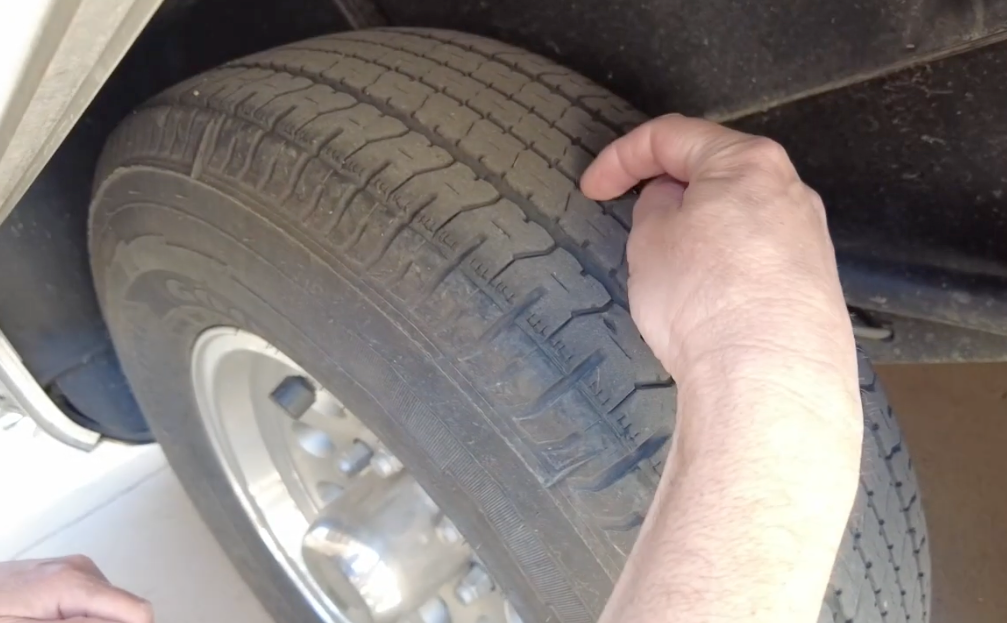
June is Tire Safety Month. With many folks heading out for their first trips of the season, now is the time to take a look at the condition of the tires on your Airstream or other brand RV trailer.
I realize that tires are the least sexy thing to think about as you prepare for a trip. But they're the most important thing to be concerned about for safe travel. Face it, if you have a flat tire while you're on the road, your trailer isn't going anywhere.
We recommend a systematic tire inspection before every trip, and any time you bring your trailer out of storage. We also do a quick tire inspection during every trip, each time we stop for gas.
The inspection is a straightforward, 3-step procedure that anyone can learn to do. I explain and demonstrate it in this video, and each step is detailed below.
1. Check the tire pressure of each tire
There are two methods to do this: a tire gauge (usually less than $10 at a hardware store or Wal-Mart) or a Tire Pressure Monitoring System (TPMS).
A TPMS is the easiest, most accurate, and most efficient way to check pressures. I turn ours on and let it boot up while I'm doing something else. All five tire pressures (including the spare) display without me having to check each one manually.
The TPMS has a big benefit over a tire gauge: it continuously monitors pressures while you're driving, and alarms when they go too low. This is essential for avoiding blowouts and getting safely off the road if you have a flat.
Whether you use a tire gauge or a TPMS, add air to each tire that's reading low, then take the pressure again to make sure it's at the recommended level.
What's the right tire pressure? We recommend following the manufacturer's recommendation about the correct pressure. Most late-model Airstreams come with Goodyear Endurance tires which need 80 psi of air pressure when they are “cold," which means before you start towing. This is why you want to check the pressures while you’re getting ready to go.
Pro Tip: If the temperatures have dropped dramatically in your area recently, you may find that the tires need a little more air in the morning to reach the correct pressure.
Some people choose not to go with the tire manufacturer's recommendation. In that case, here are some things to consider as you think about which right pressure is right for you.
2. Perform a visual inspection of each tire
Look for things like this:
Objects embedded in the tire treads – a screw or nail in the tire will be obvious, like in the photo below, and must be removed and patched before you travel. A bit of gravel is normal and usually nothing to worry about.

Signs of wear or cracks in the sidewalls – initial signs of wear won't necessarily kill your trip. But you should keep an eye of them because they indicate that you'll probably need to replace the tire soon. (Another reason why regular inspections are recommended).
Indication of significant wear on the tire tread – this can show up as thin spots or bald patches on one side of a tire, but not the other, and might be due to an alignment problem or a problem with the tire itself. You need to address this before you go on your next trip. For example, this tire shows significant wear on the right side, and should be replaced.

3. During each trip, inspect your tires at every gas and rest stop
You’re checking for the same things as in step 2, in an effort to catch the nail you ran over in the last 100 miles, as well as stay ahead of any problems that might be brewing.
Make this inspection a habit–it only takes a minute. I do it every time we stop during a tip and here's my process:
A few additional recommendations
Travel with an air compressor
In an unfamiliar town it can be a real pain to hunt down a gas station that has an air compressor. That’s why I always carry a portable air compressor and an extension cord. I can add a little air to the tires anywhere, anytime—and that’s a huge convenience.
Late model Airstreams have inverters built in, so with an extension cord you can use a 120-volt AC (household power) air compressor. Portable ones are inexpensive (less than $40), light, small, and come with convenient carry bags. Simply turn on the Airstream’s inverter and plug the air compressor into an inside power outlet.
I recommend this approach if possible, because it will be much quicker at filling tires than a 12 volt DC (battery powered) air compressor. Look for compressors at auto parts stores, hardware stores, and general merchandise stores.
Travel with the right tools for changing a tire
Despite the best maintenance efforts, flats still happen. Your Airstream may have come with a lug wrench but it won't help you if you need to change a tire. Make sure you have a complete tire changing kit, plus leveling blocks, and if you have a single axle trailer, a jack. Any quality brand bottle jack will do.
5 comments
Brian Powers
I agree, at each stop inspect all tires both the Airstream and Tow Vehicle. I do this every single time. One thing I have learned that I have trained my eye to find early signs of unusual tire ware and stuff stuck into my tires like screws, nails and even a broken drill bit. At my last caravan I spotted a screw embedded in my tire when I arrived. I mentioned this to others that I was traveling with. They wanted to see the embedded screw. To my surprise what stood out like a soar thumb they could not see the embedded screw. Hence, I believe that constantly checking my tires I have trained my eyes to see something that is not normal. So inspect, inspect and inspect at every stop. Travel safely and see you down the road.
Lawrence
One more thing to add to your rest stop walk around inspection. Check that running and signal lights are all working. As a trailer boater I was taught to always drive with my lights on when towing. That has carried over to towing my Basecamp and it makes it easier to remember to check my lights.
Mark Helmkamp
Greetings Rich,
Since you’re in the neighborhood while performing the tire check, I recommend having a look at the shocks. In our newest Airstream, a 2025 with only about 10k miles on it, I’ve replaced FIVE of the Gabriel shocks, one was replaced during pre-sale acceptance at Airstream of Tampa. All had seal failures, were covered in oil and grit and could be easily compressed. I checked shocks again while in Maine recently after an 1,800 mile drive up from St. Pete and replaced all four with Monroe Magnums, Part number 55503 (about $65 each). The Monroe shocks are made with slightly larger tubes, so have a greater amount of oil in them and seem to keep the trailer better “planted” wile on the road. They are easy to replace; require no special tools and can be swapped out with the tires mounted and the trailer on the ground.
Anonymous
Ella, a mirror might work if there’s plenty of light. I haven’t tried that. I just throw a towel on the ground and slide under the Airstream with a flashlight, if I want to see the inside sidewall.
I don’t inspect the inside sidewall routinely. If the outer sidewall has cracks from too much sun exposure or age, it will likely be about the same on the inside, and that’s enough to tell you it’s time to get new tires.
Ella
Hi Rich! Thank you for all your helpful information. How does one inspect the inside sidewall surface of the trailer tires? I’m thinking of using a mirror. What do you do? Fyi, I’m towing a Basecamp 20X.
Thank you,
Ella Menendez