
I like ice cream. And really, who doesn't?
So when we travel in the Airstream, there's usually a pint or two in the freezer. And it's usually mushy, because the freezer just can't get cold enough on most warm days. This annoys me.
In my last Airstream, I installed a pair of cooling fans to help improve the air flow past the refrigerator's coils. They didn't make the freezer as cold as my home freezer, but they made a big difference on very hot days. My ice cream was no longer a mushy mess.
When we got a new Airstream in 2020, I had hopes that the factory-installed cooling fans would be sufficient. Our Globetrotter came with two fans. One is shown in the photo, and the other is located much higher up in the "chimney."
Alas, they aren't enough to keep the freezer very cold. At least not in our southwest heat. You can see in the photo below how small they are–about 3" square–and they just didn't seem to have the "oomph" to get the job done.

The Fix? Install Refrigerator Cooling Fans
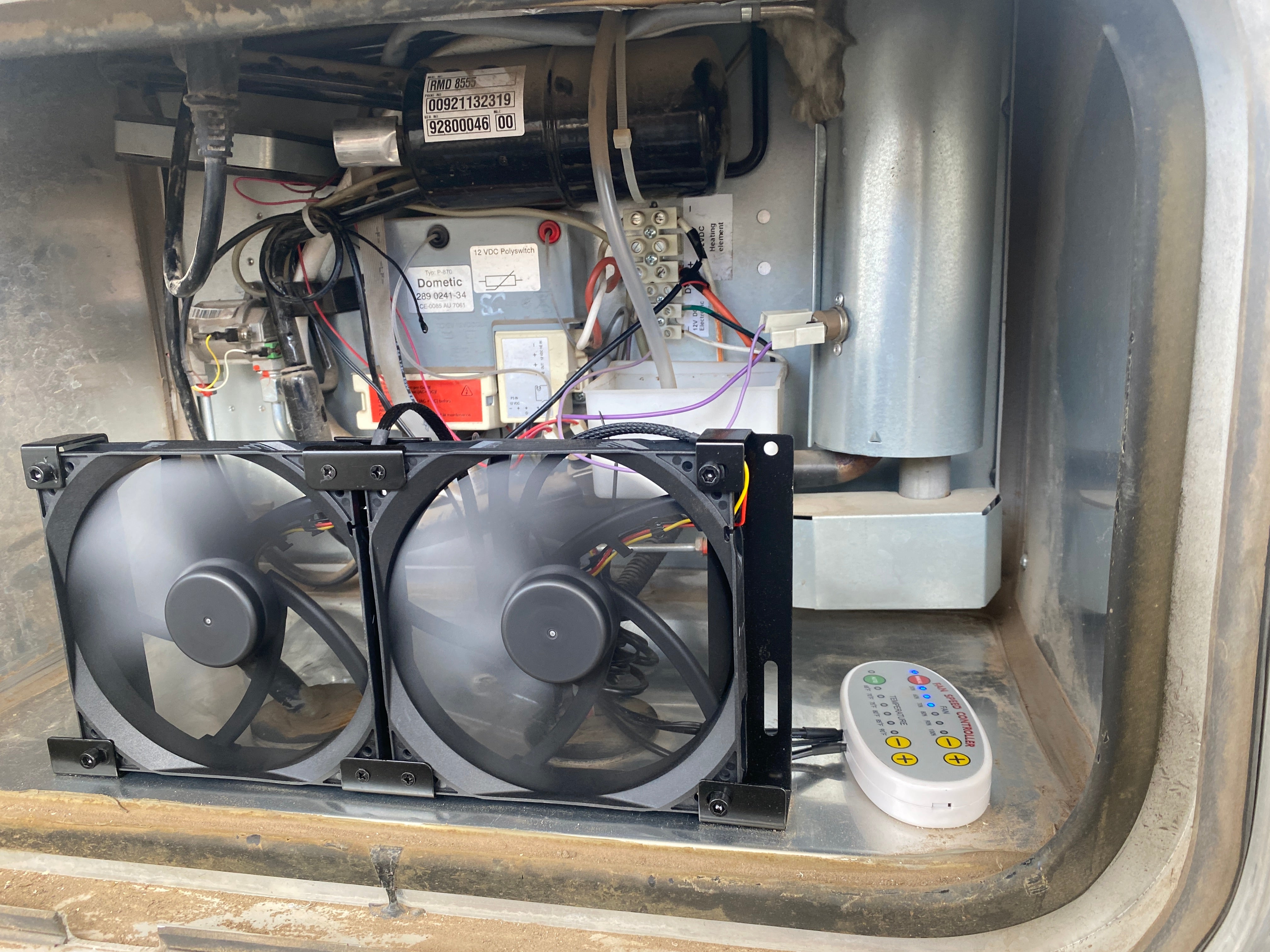
This spring, my annoyance with eating mushy ice cream turned into a decision to finally do something about it. We're headed out for a month in July, so I bought an inexpensive pair of RV refrigerator cooling fans on Amazon and popped them into the Airstream's refrigerator bay. (We don't sell these fans.)
The purpose of the cooling fans is to help push air into the space behind the refrigerator, up and out through the rooftop vent. More air = better cooling, even on a very hot day. They act as boosters for the existing fans, if such fans exist in your model. In our Globetrotter they do, but not all Airstreams or RVs have them.
All of the cooling fans for RV refrigerators on Amazon are similar. The ones I purchased are 5.5" square each, mounted as a pair in a bracket, and they come with a nice control that offers manual and automatic settings.
Installation
Installation is pretty easy, if you're moderately handy. You don't have to remove the refrigerator. As placed in the photos, the fans create a "high-pressure" zone in the lower part of the fridge compartment, which gently helps the air move up and out the rooftop chimney.
You'll need to locate an always-on 12 volt power source, which on my refrigerator is front and center, once you open the outside access door. I piggy-backed the 12 volt positive and ground wires from the fans onto the refrigerator's power distribution block, and secured them in place with electrical tape. The boost fans pull so little power that you don't have to worry about overloading the circuit.
IMPORTANT NOTE: If you don't have a voltage meter, a wire stripper, and some prior knowledge of 12 volt wiring, please don't attempt this! You need to be able to identify which leads are "hot" and where you can find a good ground point. If you try to wing it based on my photos, you are likely to end up with a blown fuse, fans that don't work, and/or a dead fridge.

The standard fans sold on Amazon are designed to hang off a typical RV refrigerator access door, and that's not going to work on an Airstream. I simply drilled 9/64" holes in the base of the fan bracket, and riveted it right to the floor of the fridge compartment. The fans are light, so a pair of rivets was plenty. (Of course, I made sure the fans were blowing the right way—inward—before I riveted them in place.)
Tip: Shift the fans to the left, so that they won't be blowing on the gas flame. Ideally the fans should be tipped to blow air up too, if you are inclined to make a custom bracket to position them. The gas flame is shrouded, but if the fans are creating a lot of turbulence in the lower compartment they could interfere with the gas flame, and actually make things worse.

The control box that came with the fan kit had some very lame adhesive tape that wouldn't stick to the aluminum of the Airstream, so after these photos were taken, I attached the control to the floor with some 3M VHB tape. It won't go anywhere.
Initial Results?
The fans are wonderfully quiet. I can't hear them inside until they are at their highest speed, and even then it's unobjectionable. With the choice of manual setting or "automatic" temperature-based setting, the fan setup should be very convenient.
But the real test starts in July. I've got 3 pints of Culver's that are earmarked for the Airstream's freezer. Our first night will be in a campground that is likely to be at least 95°F when we arrive, so if my boost fan modification works, I'll know it when dessert time rolls around that evening.
Will I suffer the curse of mushy ice cream this summer? Time will tell. I'll update this blog later in July with the results of my cooling fan test.
--------
BLOG UPDATE: The results are in—and it's a mixed bag.
The refrigerator is cooling beautifully when running on 120V AC electricity. We're seeing temperatures of about 34-40°F most of the time. The freezer runs between 5-9°F, in electric mode.

Alas, the same is not true when running on propane. The refrigerator can't keep itself any colder than 53°F, which is much too warm for preserving food. On a really hot day, it can reach 59°F, and the freezer jumps to 19-22°F, which is terrible (and means more mushy ice cream).
So there's a lesson here: before running to add fans or other modifications, consider the possibility that maintenance is needed instead. In my case, the propane gas system needs to be checked.
I'll check the propane pressure with a manometer at the refrigerator's test port, then proceed with checking the burner valve or propane regulator as indicated. I could have a problem with the gas pressure, a mis-adjusted or defective gas valve, a dirty burner, etc. This is not a DIY for most people, so if this is all greek to you and you're having a similar problem, take it to a competent RV tech who has been trained on gas refrigerators.
10 comments
Rich Luhr
Hugh: That’s correct, I was not able to reach the evaporator, unless I pulled the refrigerator partially out. Instead, I zip-tied the temperature probe up in a spot where it would read the temperature of the space in general.
Since the cooling fan control for this model is user-settable in a range from 70° to 95°, I experimented with various speeds and settled on 85°. Note that there’s no harm in running the fan at any temperature, but keep in mind that the more you run it, the more power is consumed. This could be a small factor when boondocking. Setting the fan temperature higher could save a little battery power, if that’s concern.
Hugh McLaurin
That fan unit says to locate their temperature probe near the evaporator. Doesn’t seem feasible from the back compartment – where did you locate that probe? Anywhere specific? Thanks!
Jeffrey Curtis
We have a 2023 with the all electric refrigerator. There is no access panel. There is a chimney (big covered opening with a screen on the roof) but as far as I can tell there is no lower opening to get any kind of air flow. A fan by itself would just blow the hot air around. A fan connected to a duct that could draw air from one side of the roof opening might help, but I will need to pull the fridge out to get back there.
Rich Luhr
Kevin B and Bill Y: Yes, we have a propane refrigerator. This was the standard up to 2020 model year in Airstream trailers. Since 2021 Airstream has been installing only all-electric fridges (and even earlier in the Interstate vans).
The electric fridges get a lot of grief for being energy hogs (and they are), but the upside is that they cool better. If you have an electric fridge and you’re happy with it, congratulations!
Bill Yanke
The external fan in my 2019 Flying Cloud 20 FB was on a switch but also had a thermostat and the fan wouldn’t go on until the outside temp was greater than 86 degrees F. I removed the thermostat and almost always turn on the switch to turn on the fan unless it is relatively cool (like less than 60 degrees F). However, it is only one fan and it is small like the one you described. Since you mentioned the care you took in positioning the fans so as to not compromise the pilot light it led me to question whether or not the issue of mushy ice cream would be resolved if you were using one of the newer electric only refrigerators that seem to be standard equipment with newer Airstreams. Thoughts?
John Thompson
My refrigerator in our 2019 Flying Cloud went out completely, so I installed a new 12 volt compressor refrigerator, we went from an 8 cubic foot to a 10 cubic foot refrigerator and my Ice cream is always frozen.
Kevin Barbee
Is that a propane fridge on your rig?
Gris
May the ice cream goddesses be with you. Happy trails!
Suzy Price
I used to do this in my old Scamp, and used a small solar panel to power an old PC muffin fan. Worked great! In that case, since I only used it when parked, I jammed it up right under the main cooling fins in the top of the frig.
RD VanOrsdale
I wish you could come up with how to do the fan fix on an electric only fridge in a 2022 Flying Cloud 30RBQ. There is NO ACCESS to any part of the workings of the fridge or the coils. We do the “half gallon milk jug frozen water” trick and when on site we have a small fan blowing toward the bottom of the fridge towards the gap between fridge and fridge frame.