
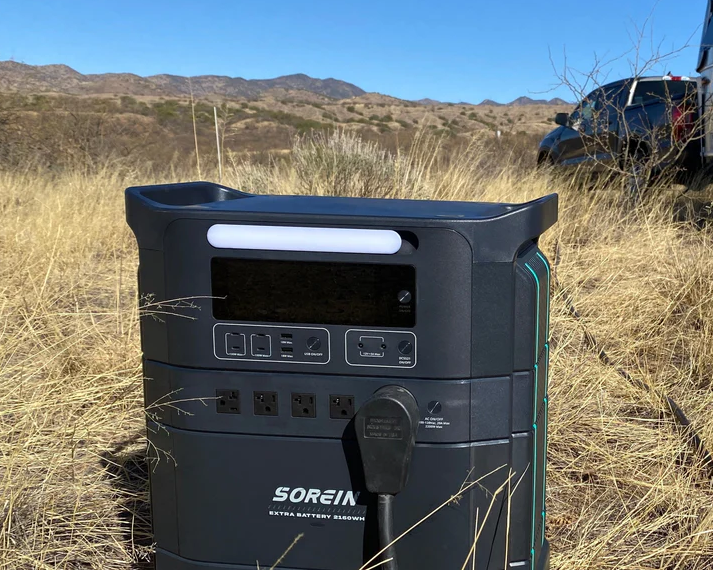
Portable power stations are becoming the next big thing for recreational vehicle owners, and a viable alternative to generators. Power stations are starting to replace generators because they have many advantages.

What can an RV owner use a power station for?
Power stations can power anything that a typical 2200 Watt gas or propane generator can. This includes microwave, coffee maker, blow dryer, curling iron, toaster, CPAP machine, and air conditioning.
In addition, power stations:
- Are completely silent – except for the occasional, quiet sound of the cooling fans – so they can be used anywhere, anytime. No need to restrict your use to "generator hours".
- Don't emit fumes or require you to carry a gas can.
- Require zero maintenance during the off-season.
- Can be recharged with a household wall plug, or solar panels, or from a truck – even while you're using them.
- Serve as a useful power backup for home appliances, like your refrigerator, when you're not traveling in your RV.
The biggest argument against using portable power stations: they aren't ideal for situations where you need air conditioning for long periods of time. The power draw of most RV air conditioners will exhaust a power station in a matter of hours, so this is the one circumstance where a generator is the best choice.
For nearly all other circumstances, a power station is a better power solution for RV owners.
The best power stations for RV travel have these features
Here's what to look for when considering a power station that you plan to use primarily for RVing:
Modularity

The only way for a power station to be practical for RVing is if it can be broken down into separate modules that are easier to lift and store. That's because RVs need fairly large power stations, and that means they can be heavy.
So, look for a brand which has a well engineered solution that breaks down into separate pieces and re-assembles very quickly, without the need for special cables or reprogramming.

Large battery capacity
If you want to be able to power everything in your RV for several days while you are away from a campground plug, you need a power station sized in the range of 3 kiloWatt-hours (kWh) to 7 kWh.
Smaller "tabletop" power stations are been popular with RV owners for charging small devices. But units with battery capacity less than 2 kWh don't have the ability to power the entire RV for a reasonable length of time.
High capacity, pure-sine wave inverter

Look for a power station that has an inverter capable of a minimum of 2000 W continuous output. Anything less, and you may not be able to power the appliances in your RV.
Note that a continuous output of more than 3000 W is generally not necessary for the typical RV traveler. 3000 W is plenty to run the an air conditioner, microwave, or any plug-in appliance you may have.
A built-in TT30 power outlet

Look for a power station that has a TT30 outlet built in. The TT30 outlet can be used with 30-amp or 50-amp cords (with an adapter for the 50-amp plugs).
Most travel trailers have either a 30-amp (TT30) plug or a 50-amp plug. But many portable power stations only have lower-capacity "household" outlets. (These are commonly called "110 volt" outlets, but they actually are 120 volts at either 15 or 20 amps.)
While you can use an adapter to step your RV's power cord down to a 15 or 20-amp household outlet, it won't be safe to run most air conditioners. There's a definite risk of overheating the adapter and/or outlet on the power station.
Cart with large wheels
It may seem silly, but given the weight of a typical large power station, it's really important to have large wheels underneath its cart. Most power stations are made with small wheels because they are designed for residential use, and it's assumed that they will be rolling on smooth surfaces.
Those little wheels won't work very well in a camping situation, because they get caught on gravel, grass, or other uneven surfaces. Look for a station that has large wheels and is designed to be rolled on rough surfaces, like the one below.

US-based technical support and warranty
All major power station brands are made overseas and sold by foreign companies with large call centers. Even if those call centers have a US number, speaking to someone overseas when you have a problem can be challenging.
A company that has a US-based technical support line and warranty makes things a lot easier if you run into setup issues, technical challenges, or RV-related product questions. Ideally, the support team has knowledge of (or even owns) an RV themselves, and can provide granular and relevant insight to troubleshooting or product usage questions. This is rare, which is why people appreciate that the power station support they get from AIR GEAR comes from people who own RVs and/or have direct experience using the product with their own RV.
3 comments
Rich Luhr
Jim B: For security, we simply use a chain and heavy-duty lock to secure the power station to the A-frame of the trailer. For more on that, see this article:
https://air-gear-help-center.gorgias.help/en-US/how-can-i-lock-up-my-sorein-2644215
We offer free shipping of Sorein Power Stations, to all 48 states.
Jim Balsitis
Hi,
I really want to switch over to these, and plan to by the end of the year. What is your take on protecting these power stations from theft at the campsite? We often are out for most of the day exploring. Can you ship these to California? Shipping cost is probably really high. Should plan a trip to Arizona? Thanks a lot. Jim
Elizabeth Wright
And the winners are…???