
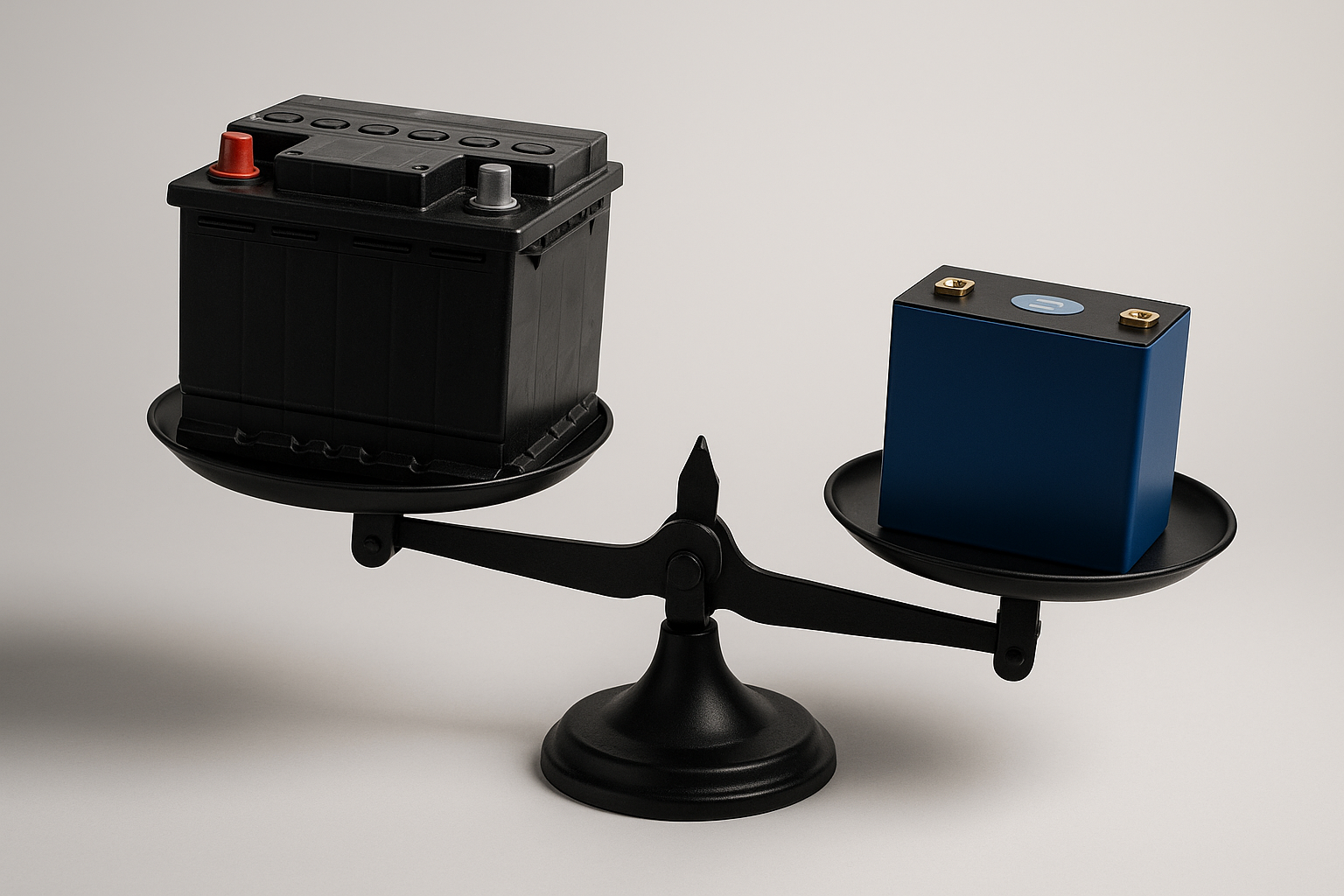
Over three years ago, in May 2022, I tossed out the dead and swollen AGM batteries in our Airstream and replaced them with lithium iron phosphate (LFP) batteries. At the time, this upgrade cost about $2,000, partly because I had to update the power converter in the Airstream. (You can read the full story of the upgrade here.)
LFP batteries have gotten a lot cheaper since then, so today the same upgrade could be done for about $1,500 (parts and tools only, not labor). But it's still a chunk of money, so it begs the question: After 3+ years of use, was it worth it?
The quick answer for us is: "Absolutely, yes." Here's why:
More power in the same space
First and foremost, LFP batteries can store a lot more power than the lead-acid batteries they're replacing. We went from 62 Ah to 200 Ah of usable capacity—tripling our off-grid camping time—without requiring a complicated custom battery installation.
(A big part of the reason for this is the fact that lead-acid batteries shouldn't be used below 50% of their rated capacity, while LFP can be run down to 0% without significant damage. So effectively, two 62 Ah lead-acid batteries still only give you 62 Ah usable power.)

For our purposes, the 200 Ah (2,560 Watt-hours) offered by a pair of LFP batteries has been plenty for our typical off-grid trips. With the original batteries, we'd struggle to get through 36 hours. With the LFP batteries, boondocking up to 4 days is no problem.
Reliability and durability
Once you have lithium batteries it becomes obvious that lead-acid batteries are somewhat delicate, because:
- They can't be discharged below 50% without drastically shortening their lifespan
- Some lead-acid batteries need maintenance (adding distilled water)
- They're very susceptible to damage from over-charging and under-charging
- Lead-acid batteries "self-discharge" at an alarming rate during storage
LFP batteries are much tougher, partly because they come with a built-in Battery Maintenance System (BMS). The BMS protects the battery from many kinds of problems, such as over-charging, shorts, excessive current draws, low temperatures, etc. Rather than let the battery be damaged or operate in a dangerous situation, they shut down the battery until the problem is corrected.
This, plus the inherently more rugged chemistry of LFP batteries, means they need no maintenance, last longer, and can put up with more of the type of hard use that comes with RV camping.
All of this adds up to a better value, despite the higher initial cost. It's easy to get 8-10 years from a set of LFP batteries. After more than three years of heavy use, our LFP batteries have had no problems, and show no signs of deterioration.
Faster charging
If you're a frequent boondocker, you'll love the fact that LFP batteries charge faster than lead-acid. A pair of 100 Ah LFPs can charge at up to 1,200 watts (although your RV's power converter is probably limited to 700-800 watts output) which means quick recovery time when you get to plug in, or if you have a big solar array.
This is especially important if you recharge with a generator. A pair of Interstate 62 Ah AGM batteries can be safely charged at no more than 400 watts, and regular lead-acid batteries have an even slower charge rate. So when you're running a typical 2,000 watt generator, you're wasting gas and time waiting for the slow recharge rate of lead-acid batteries.
Easier storage
One of the biggest hassles of lead-acid batteries is that they have to be kept charged during long storage periods. In the winter, this means keeping the RV plugged in, or removing the batteries to put them on a battery maintainer in your garage.
Some brands of LFP batteries, thanks to the on-board BMS, can be put into storage mode. (Sometimes this is called "warehouse mode" or "shelf mode" depending on the manufacturer.) In this mode, the batteries will sleep for months.
Even if your LFPs don't have this mode (Battle Born does not), there's no need to remove the batteries from the RV, because the self-discharge rate is very low. Just charge them fully before storage, and ensure that they are electrically disconnected from everything.
Conclusions
Overall, I'm very glad we made the switch. In addition to the benefits above, this experience has opened my eyes to the potential of lithium batteries for RV travelers.

In particular, we've discovered how well they coordinate with our Portable Solar Kit. Between the LFP batteries and the portable solar panels, we're able to boondock indefinitely, without scrimping on power, as long as we get a few hours of sun each day.

When we head to a cloudy place, and on trips where we might want even more power (such as when we plan to use the laptops a lot, or when we might need to run the air conditioning for an hour or two), we expand our battery capacity further with a Sorein Power Station.
This modular system allows us to add anywhere from 1000 Watt-hours to 7500 Watt-hours (83 to 625 Ah), simply by plugging in, so we're set for anything.
Recently we took a Sorein Power Station with 3200 Watts of battery capacity (like the one pictured above) to the Albuquerque Balloon Fiesta for 3 days of boondocking. With our solar panels, we had so much excess power that we were able to splurge on 1.5 hours of air conditioning on two of the days—and left the event with full Airstream batteries and 38% of our Sorein Power Station capacity remaining!
Bottom line: LFP batteries are an investment I recommend to anyone who ever camps away from hookups. The higher initial cost pays you back in convenience, longer battery life, and enhanced ability to use your RV the way you want to.