
On today's Sunday morning bike ride, one of our cycling buddies shared that last week he was stuck in New York for two extra days due to a snowstorm. Never mind that it's currently 89 degrees here in Arizona, and the first rattlesnake of the season crossed our path this morning. Many of you live in places that are still cold, and we see this as a wonderful opportunity to get out in your Airstream and enjoy it.
As I've shared before, Tothie and I love cold weather camping. For us, there's no such thing as bad camping weather–only bad camping preparedness. The air is crisper, the crowds are thinner, and winter scenery is a nice change from our desert home. Plus, there is something about camping in the cold that is just, well, cozier and quieter. That's why we head out for a cold weather trip at least once or twice each winter – often to a higher elevation here in the Southwest.
So when people ask us whether it's OK to travel in their Airstream when the temperatures are below freezing, our answer is an enthusiastic yes!
All Airstream models are built for freezing temperatures. A night that dips down to the 20s won't be any trouble at all—as long as you take a few precautions. Because as I said: there's no such thing as bad camping weather–only bad camping preparedness.
Here are some of our best strategies for making a cold weather camping trip great.
1. Leave with two full propane tanks
Full propane tanks are a must. You're going to run the furnace a lot, and that will burn up a lot of propane when temperatures are below freezing at night. It's easy to go through a full tank in just a few days.
In addition, do a little research and note the names and addresses of places you can get a propane refill near your camping spot. If the weather is colder or windier than you expected, the furnace could run a lot more than you planned for.
To conserve propane on cold nights, we usually set the nighttime temperature at 62° F. This is a balance between propane conservation and comfort. With a few extra blankets on the bed (or a warm partner, or a dog), it's very comfortable.
2. Leave with fully charged batteries
Never leave for a cold weather trip without a full charge in your Airstream batteries.
When the weather is cold you'll use a lot of electricity, primarily because the furnace uses a surprising amount of power to run the blower. On a very cold night the furnace can cycle on and off every few minutes, consuming 25-40 DC amp-hours by breakfast. Add to that your normal daily electrical usage from things like an electric refrigerator, and you could be out of power in 24 hours.
3. Travel with an additional power source if you plan to boondock
Having an electric hookup is the best option by far in cold weather. But if you're in a remote campground, that might not be an option. And after a few days of winter boondocking, you're going to need more power.
The optimal additional power source option in winter is a portable power station. Although I'm certainly a fan of solar panels, in wintertime the sun-gathering opportunity is much less due to low sun angle and cloudiness. Solar will still work, but it might not be enough for the entire trip, unless you are very miserly with power use.
Traveling with a portable power station like this one can give you up to 7.5 kWh of additional power for your trip. If you've already upgraded your Airstream to lithium batteries, the combination of those batteries plus a power station gives you a significant amount of power to work with.
Plus, the cost of a power station is a fraction of what you'll pay for a custom lithium battery upgrade.
A generator is another power source option. It will certainly work in the cold, but I'm not a big fan of using a generator to recharge the batteries because in addition to the noise and fumes they create, they're very inefficient.
4. Run the furnace regularly
This is obvious for keeping yourself warm, but there's another reason, too. The fresh water plumbing is all contained inside the body of an Airstream trailer, and it's not a good idea to let it get too cold.
The holding tanks, on the other hand, are below the floor, outside of the heated space. And on most Airstreams, the furnace has a little duct that spills some heated air down to the holding tanks to keep them from freezing. (On other Airstreams, there's an electric heating pad for the tanks.)
So let the furnace run. If you are comfortable, the plumbing and holding tanks will be too. (If it's really cold, you might leave the cabinet doors ajar to let warm air circulate inside.)
And avoid this cold weather camping mistake: Don't try to "save propane" using a portable electric heater inside the Airstream. The holding tanks under the floor won't get warmed, and they could freeze in extreme weather. You should use only a portable electric heater when you're confident it's not cold enough to freeze the tanks.
So again, run the furnace.
By the way, if your Airstream came with an air conditioner that has a "heat pump" mode, it will work during cool nights, but not cold ones. Many heat pumps are not much use below 40° F. There are two reasons for this:
- It outputs warm air from the ceiling, so the floor tends to be uncomfortably cold.
- It may not work when the temperature is below (or near) freezing.
In very cold weather, the furnace is your best friend.
5. Watch out for humidity
When your Airstream is all closed up in the cold, humidity from showers, cooking, and boiling water for tea can create a humid environment that may lead to future mold and other issues. If you're not careful, you'll start to see moisture running down windows and walls.
The simplest way to deal with this is to crack a roof vent and one window slightly during daylight hours, when the temperature is warmer. This won't let too much cold in, but will let humidity out. Sometimes we also add a few minutes of running the fans to blow out the moisture.
Last year we upgraded our air conditioning unit to a GREE brand unit. In addition to being significantly quieter than the factory-installed Dometic, it also has a dehumidifier setting which dries out the trailer incredibly fast (without making it cold).
Another option is to travel with a small dehumidifier, and run it daily.
6. Add barriers to windows and skylights
Both transfer a lot of cold air. We bought thick, cloth-covered squares of foam from Amazon to stuff into the skylights and they work quite well. Some Airstreamers cut pieces of window insulating film (available in rolls at most big box stores), and place them on windows at night, behind the curtains. They can be removed during the day.
7. Avoid frozen hoses
If you have a water hookup and a typical vinyl hose, disconnect it at night and let it drain. Those hoses can fail if they are allowed to freeze. (If you have this RV Water Hose you won't have to worry because it won't be harmed by freezing.) If you have a water filtration system that contains filters, bring those in from nighttime freezing temperatures too.
In extreme temperatures, like close to zero degrees, you may find the dump valves frozen in the morning. This is rare but if it happens do not attempt to force them open. Wait until temperatures rise before trying to move the valves, or you'll damage the seals and they'll leak.
8. Fill the fridge with your favorite winter provisions
When it comes to cold weather camping, we don't skimp on comfort foods or beverages. Both contribute to the cozy experience inside our Airstream when the weather is cold on the outside.
For example, coffee starts the day but after that, we prefer tea. Two winter favorites are Trader Joe's Chai and Cinnamon Apple Spice tea, both of which keep us warm and make the trailer smell great. Warming foods like oatmeal, eggs, and pancakes are staples for breakfast.
Since it's dark (and colder) by 5pm during the winter, we rarely feel like bundling up and heading out for dinner in town. Instead, we change into sweat shirts and flannel pants, and cook for ourselves. Tothie packs pre-made soups and grains, and plenty of vegetables and proteins to make stir fry and sauteéd meals. Hot, fresh-made popcorn is a frequent treat after dinner.
9. Take the right clothing and footwear
This one sounds like a no brainer but if you don't pack a few specific things for the cold, your trip can become highly unpleasant. We've been there.
A couple of things we've learned: Buy slippers or house shoes that have a hard/gel bottom. Cold temperatures under the trailer translate to cold floors that even the thickest socks can't guard against. Having a barrier at the bottom of your slippers or house shoes will make a huge difference in your comfort. (Even if you have rugs.)
Under layers are an immense help. Good old fashioned long underwear, or thermal layers will keep you warmer than just a sweater or sweatshirt–especially if you're lying around the trailer reading or watching movies.
Of course, if you plan to enjoy winter activities such as skiing, mountain biking, or winter birdwatching, pack the appropriate gear for the experience.
10. Take extra blankets
We pack two extra queen sized and two extra twin bed sized blankets when we camp in the winter. We recommend the "fuzzy" or fleece kind, usually made from polyester. In our experience, they are warmer and softer than any other material we've tried. One of our favorite indoor activities on cold weather trips is to snuggle into our twin beds under the blankets and read a good book with a hot cup of tea.
These extra blankets also double as a warm barrier between us and the cold wall of the Airstream that's next to each twin bed. (Throw pillows work well for this, too.)
11. Be careful when towing on winter roads
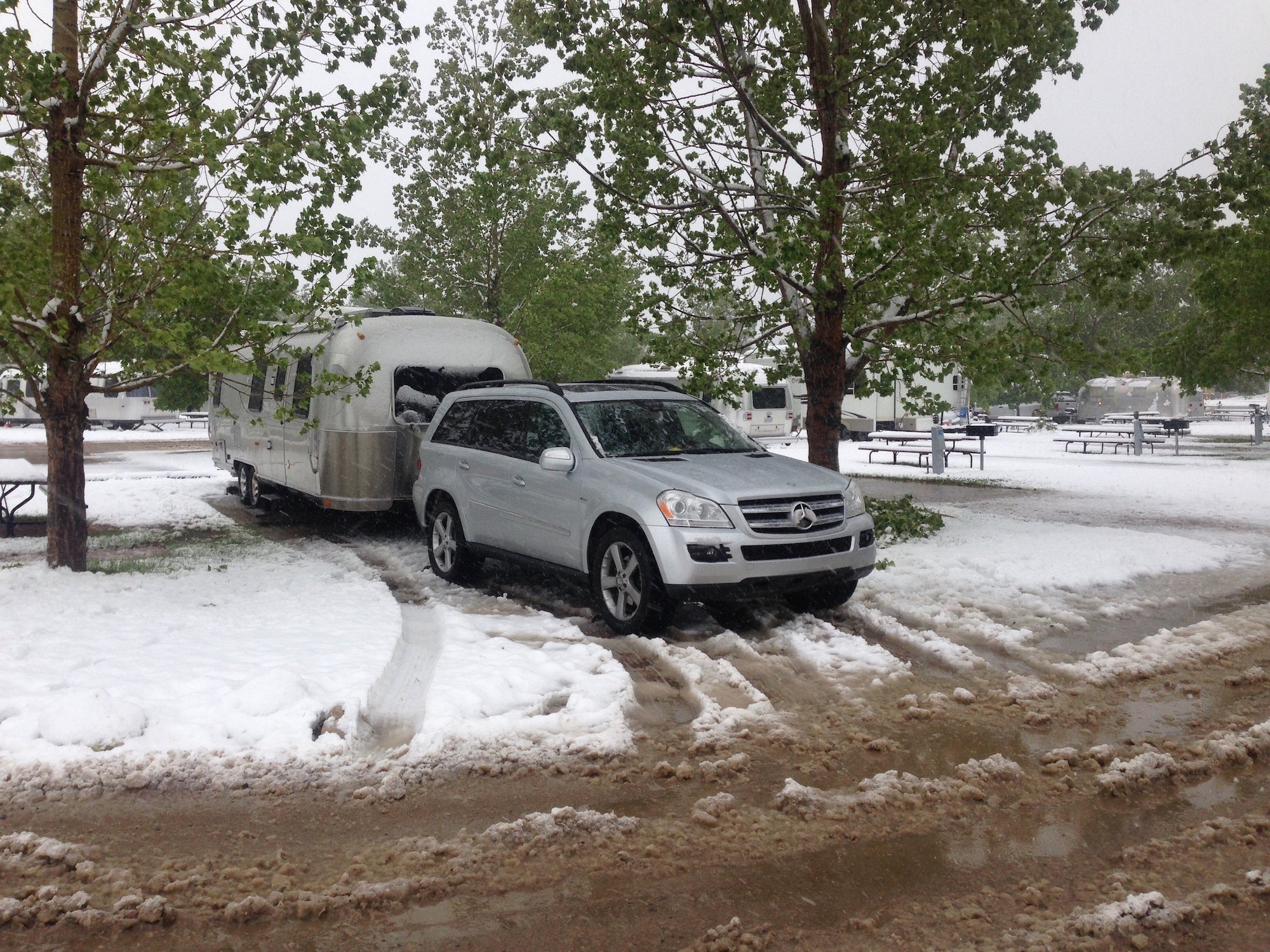
During winter I'm vigilant about checking the weather forecast for significant snow accumulation, or ice. If you're in a warm climate like us, you probably don't have winter tires on your tow vehicle. We don't have four-wheel drive on our tow vehicle, either. So with the added weight of a trailer, getting stuck can be a real risk–especially if you've got to tow in and out of a slushy campground, like the one pictured at the top of this page. Fortunately, my tow vehicle at that time had All-Wheel Drive, but generally speaking, try to avoid snowy conditions unless you are experienced at towing.
Driving the Airstream down a snowy mountain road is also a formula for disaster if you aren't very careful. Before any winter camping trip, verify that your trailer brakes and brake controller are properly adjusted.
In addition to all of this advice, keep your speed down in snowy weather. When in doubt, pull over and wait it out, just like you would with a severe thunderstorm. A couple of hours of sunshine can make a huge difference on the roads.
Late-season and cold weather camping can be awesome, and your Airstream makes it possible. Don't fear the cold. Follow these preparation strategies and you'll have a great time.
6 comments
Jim (Spike) Carsten
Good info and advice, Rich. Humidity is a real problem in our Airstreams. We are now carrying a small humidifier which has helped keep the humidity condensation manageable.
Jim Carsten
Anonymous
Wow — lots of comments! Here are some quick answers:
Heidi and Mary Ann: The black and gray tank valves and pipes will not burst or crack due to freezing, for two reasons. (1) You’re constantly adding warm water to those tanks, as you use the Airstream. (2) Those pipes aren’t pressurized, so if ice does form, it has room to expand (back toward the tank). Usually the only problem is a stuck valve, and that will take care of itself if temps go above freezing during the day.
Mark: Dehumidifying is indeed important! But you don’t need a dehumidifier: it’s far easier and more effective to simply crack a roof vent and one window to allow a small amount of fresh air in.
Randy: Yes, you can try running the furnace during travel but it may not be enough to prevent a plumbing freeze — and there are other risks. You could kill the trailer batteries (the tow vehicle’s charge line may not be enough) and if you run out of propane you’re screwed.
I talked about these issues and others, in the video “7 Tips For Cold Weather Travel In An Airstream”, which you can find on our video page under “Tips and Tricks”.
Randy Mathern
informative!
how about when you’re driving down the road and encounter cold temps… can you keep the trailer warm with gas furnace while driving??
Mary Ann
What about adding anti-freeze chemicals in your black or gray tanks?
Mark
You missed several important points!
1) Dehumidifier – this is vital since your coach will be buttoned up tight and you’ll be breathing, cooking with the propane stove and heating ~ all sources of moisture. Otherwise the walls will start dripping.
2) Insulating Window Coverage – Our single pane windows transfer a lot of cold. A simple roll of silver insulating window from any big box store can be easily cut down to cover all windows just by propping them in place behind curtains. During the day they’re easily removed. Don’t forget any skylights, too!
Heidi McCormick
Question regarding the dump valves on our 2015 23FB international. You mention the we should not try to force them if frozen. But isn’t there a danger that the exposed portion of the black lines & valves could burst/crack due to freezing? I have read where others have wrapped electric heat tape around the exposed areas of the dump valves. But that heat tape requires electricity that you might not be available if you are boondocking. Should I not be concerned about freezing and breaking the exposed dump lines and valves?