
Many times I've towed my Airstream across the country, watching for severe thunderstorms, tornados, and hail.
And every time I make a trip, I wonder if this might be the year my luck runs out.
I've come close
Once in North Carolina I had to abandon the Airstream and shelter in a Wal-Mart while a tornado whipped through. I was amazed that the Airstream survived! The Class A motorhome parked near me tipped over on its side.
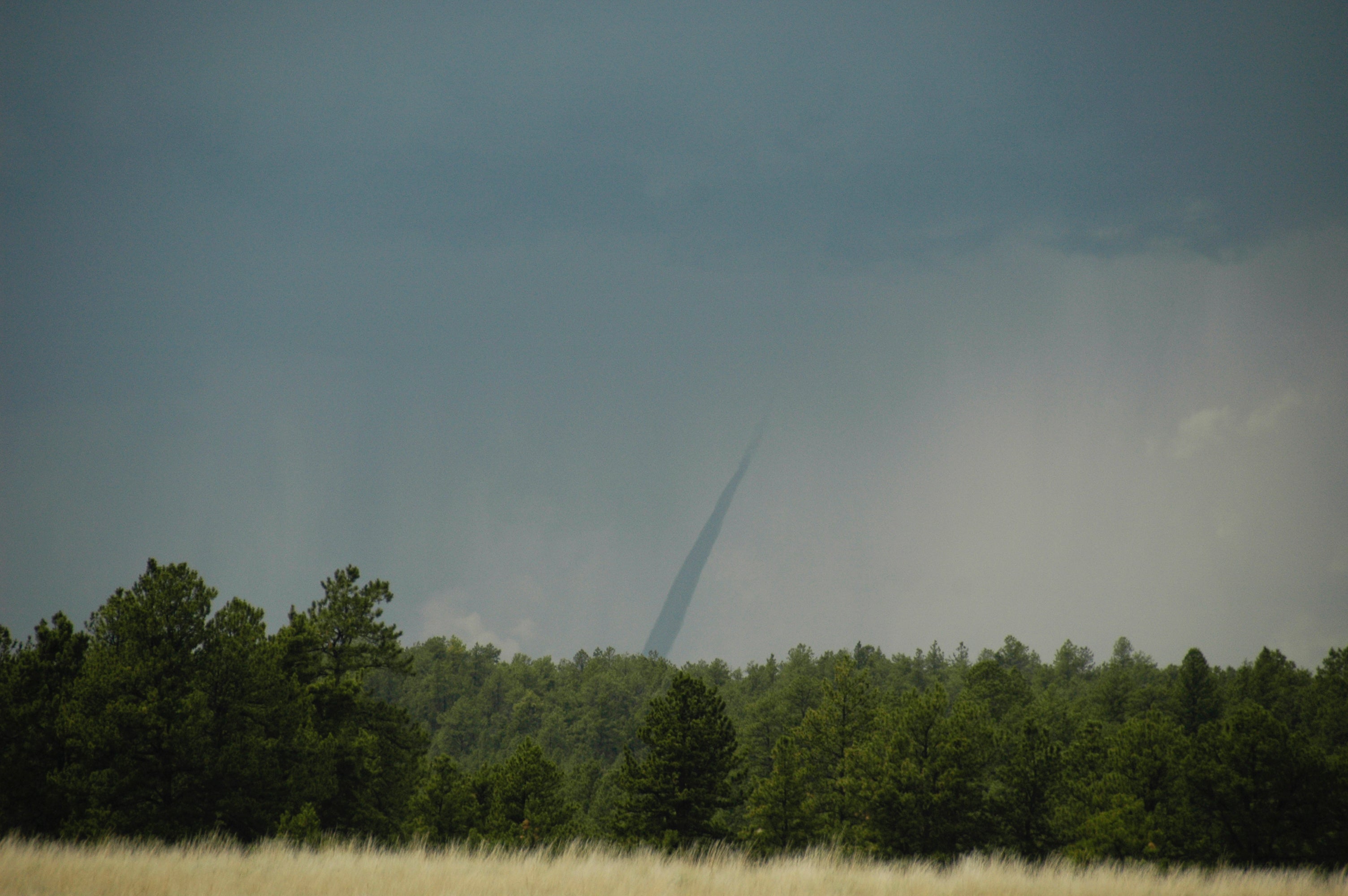
Another time, in Colorado, I spotted a funnel cloud on the horizon. In fact, that's the actual funnel cloud in the above photo. You can bet it got my attention! We quickly headed for shelter.
And several times I've been caught in hail, pitch-black rain, flooded roads, and high winds. Each time I lived to tell the tale, and learned a few lessons about weather.
Here's how I've avoided total disaster each time:
1. KNOW THE TYPE OF WEATHER TO AVOID
Thunderstorms are the main problem. Hail and tornados—two things you do not want near your Airstream—come from severe thunderstorms. Not all thunderstorms are strong enough to produce damaging weather, but here's how you can spot the possibility:
- Look at the weather maps and radar to see if large "fronts" are moving through your area. On a weather map, fronts are depicted with blue or red lines. Fronts are areas where cold air meets warm air, and that's where thunderstorms are likely to form.
- If the weather report mentions strong frontal activity, a rapidly moving front, or chance of severe weather you need to pay close attention. Don't take these warnings lightly. And by the way, the phrase severe weather almost always means thunderstorms.
- Be extra cautious on hot, humid days. Those are ideal conditions for thunderstorm formation.
- Tornado warnings are a major red flag since tornadoes are spawned from severe thunderstorms. Don't travel anywhere near an area with a tornado warning.
2. CHECK WEATHER APPS FREQUENTLY
Download weather apps to your mobile device, so you have them at the ready while traveling. There are many that show live radar, and those are particularly useful for checking changes in the weather during a trip. You can use radar to see if thunderstorms have emerged along your route.
It's also a good idea to check the weather report every day before you start driving, particularly in the summer when thunderstorms are most prevalent. Consider this an essential "pre-flight" check.
Keep in mind that weather maps generally show forecast weather (what's expected to happen in the future) while live radar shows what precipitation has happened in the last few minutes. Radar is typically 5-20 minutes out of date, so a storm that appears to be nearby on the radar might already be on top of your route.
Make sure you know what you're looking at, so you can understand what's predicted to happen, what's happened recently, and how that might translate to what's happening now.
 3. CONSIDER ALTERNATES WHEN THE WEATHER LOOKS RISKY
If you think the risk of thunderstorms along your route is high, make a different plan for the day. This can be disappointing if you had a specific plan you were looking forward to, but it's essential for staying safe.
I never hesitate to re-route to avoid possible severe weather, even if it adds many miles to a cross-country trip. Once, on a trip from Austin TX to Jackson Center OH, I detoured via New Orleans to avoid major thunderstorms. It added 200 miles but was definitely worth it—and, I got a nice evening in the French Quarter as a bonus.
So, if the weather forecast is ominous, stay put for an extra day, tow a shorter distance, or change your route. The only wrong decision would be to knowingly plow ahead into an area of volatile weather.
4. GET OFF THE ROAD AND LOOK FOR EMERGENCY SHELTERS
The best option is always to be off the road before a thunderstorm hits. Sometimes people are reluctant to do this because they don't want to stop, but keep in mind that the dangerous part of a single thunderstorm can pass over in as little as 20-40 minutes. Don't think of this as an inconvenience, think of it as a simple step to avoid a disaster.
If you do get caught in severe weather, look for any safe place to stop, as soon as possible. Don't waste time hunting around for a place with cover for your Airstream, as people often do. We'd all like to find a convenient gas station with a tall canopy, or an Interstate highway overpass to hide under, but every other RV'er is probably looking for the same thing. Since time is of the essence, park anywhere that's safe, and seek shelter for yourself if a tornado is a possibility.
Pro Tip: When you arrive at a campground, take a moment to spot a shelter, just in case something awful arrives in the night. Often there's a bathroom or shower area made of concrete block or brick. Share this knowledge with your traveling companions.
5. DON'T TRY TO OUTDRIVE THE STORM
Thunderstorms can move quickly, and tornados can move even more quickly. Their movement is hard to predict, too. So when a funnel cloud or other dangerous conditions appear (high winds, heavy rain, hail, low visibility) you should regard that as an emergency. Continuing to drive on the highway with disaster looming in your rear-view mirror is foolhardy.
6. DON'T WORRY ABOUT THE SOLAR PANELS ... or ANYTHING ELSE
Rigid rooftop solar panels are always viewed as very susceptible to hail damage because they are made of glass, but the glass is actually very tough. It’s tempered and typically capable of resisting hail one inch in diameter without any damage. The Airstream’s aluminum roof might show dimpling long before the solar panel glass breaks.
That said, none of this matters when the weather is dangerous. Things can be replaced or repaired. But you, your family, and your pets are irreplaceable.
7. HAVE A PLAN FOR BAILING OUT
If a tornado is coming and you're in the Airstream, do you know what you'll grab before you depart?
Create a plan and a list of things you need for the next 24 hours, so you can grab them quickly. It might include turning off the propane, taking essential medications and the dog and his leash, as well as prepping a bag with your rain jackets, water, a weather radio, your wallets and phones, a snack, etc.
I've had to use my personal list only once, during that tornado in North Carolina. It was terrible to take just the essentials and leave the Airstream to its fate, but I was glad that I was ready. Fortunately, it turned out well.
We will be crossing the country again this July, this time from Arizona to Colorado, then up to Michigan, and Wisconsin. This week, we're updating our "bail out plan" checklist. As always, we will have weather apps at the ready, and my eyes will scanning the skies. If the weather becomes too volatile, we plan to detour or sit tight. Re-booking a campground is a lot easier than filing an insurance claim.
Even though severe weather is scary, don't let fear of it overshadow your good times. Just being aware and taking these few sensible steps will greatly reduce your risk.
11 comments
Kevin McCarthy
Following up on Greg’s comment, we use the Watch Duty app to track fires. This was very helpful a couple weeks ago to avoid the almost 100K acre Cottonwood fire in Utah.
Rachel
It’s also helpful to know the name of the county your campsite is in, as well as surrounding towns. If you don’t have great cell signal and are relying on a weather radio, this may be the only way to tell ahead of time if you’re in severe weather’s path.
Rich Luhr
Mike: I use an app called “Weather High-Def Radar” to keep an eye on storm progress, but there are many good apps out there that do the same thing,
Duncan: We’ve got a blog all about hail here:
https://www.airgear.store/blogs/travel-planning-and-tips/hail-no-6-tips-for-avoiding-hail-damage
Laura
So appreciate this advice and recommendations.
David B
Great write up on preparations for travels with your Air Stream. Situational awareness on the road or in the camp site needs to be ALWAYS on our minds.
Michael Carden
Nicely done! All good suggestions.
Greg Horner
Excellent and timely too Rich! Also, as we’ve traveled multiple times during the summer through the US west and Canada, it’s timely to remind people to keep track of forest fires in the area! We’ve had too many to track, and Canadian and US fire forecasters have different uses of terms, such as contained and controlled. We’ve traveled just ahead of fire fronts, where we had no other choice (AK & Canada have only so many roads!!), but we were aware of fire progress as we advanced ahead to avoid being trapped or blocked behind active fires. Just a timely reminder! Enjoy your trip to Michigan and Wisconsin, we’ve traveled to the UP of Michigan multiple times! Many good breweries along the way!!
Duncan
And that is some very good information in your article. Thanks a bunch
Duncan
Is there a known size of hail before it damages the Airstream outer panels?
And are there any DIY methods to remove hail damage?
Mike
Thanks again for a well thought out post. Do you have any special weather apps you depend on? Thanks again
Gary Armstrong
Great Input! We were camping in West Virginia when the June 29th, 2012 Derecho came through from Ohio to North Carolina, wiping out power throughout all these states. There was not much of a warning where we were, and we had to hunker down in a large RV in seconds. Luckily we came through unharmed, but we had to drive back to Virginia Beach the next morning. We had just enough gas to get us to one of the only gas stations open, but it was cash only. There were probably 20+ cars waiting for gas and the gas was running out. People were filling up anything they could find to put gas in. Gas was all over the parking lot from over fills. It was like another disaster about to happen. I believe we were one of very few vehicles left that got gas, it was about out. I recommend filling up your RV/Camper before you pull into camp and have plenty of cash just in case power goes out. We counted probably 4-5 gas stations open on our way home that day. Most had some type of damage or couldn’t get help to open up. Very long day of slow driving with trees and limbs all over. Safe camping peeps!!