
June has kicked off with some pretty oppressive heat. Much of the U.S. is melting under heat indices into the upper 90s and triple digits. If you're traveling in, to, or through the Northwest, East Coast, or Plains states this weekend or into next week you're probably going to be pretty uncomfortable given the sultry combo of heat and humidity.
Many times I've crossed Kansas or Oklahoma or Missouri and been nearly steamed to death in what the meteorologists call "oppressive humidity." And of course here in Tucson, we're no strangers to extreme temperatures.
Here are a few of the things I've learned over the years:
1. Don't have overly-high expectations for the air conditioner
The air conditioner can be overwhelmed when camping in extreme heat. Many people, especially newbies, are surprised to discover the limitations of a single air conditioner on a 30-amp plug. If you've got a newer Airstream with dual air conditioners (and a 50-amp outlet to plug into) you can deal with just about any level of heat. But a single A/C (which is what we have) definitely has limits.
A properly operating RV air conditioner will generally cool the incoming air by up to 20 degrees, but that doesn't mean your trailer will be 20 degrees cooler, especially if it's sitting in the sun. On a sunny 105-degree day, the trailer interior might be well into the upper 80s until after dark.
That's why for us Tucsonans there very few places we can comfortably camp in Arizona, in the summer – and they are all at high elevation. Summer in the southwest is our "off season" (which is why we are heading to Michigan and Wisconsin in a few weeks).
What to do if you're stuck in the heat? Try to park in shaded campsites and avoid asphalt parking lots. Generally speaking, green surroundings = cooler air. You also need to have realistic expectations. If the trailer is over 100 degrees inside when you arrive, it will take hours before the air conditioner can remove all the latent heat that is stored in every object in the interior.
To cope, try to spend the first couple of hours somewhere else (like a restaurant or visitor center) while the air conditioner does its job. Don't even dream of using the stove or oven—the burners will put out much more heat than the air conditioner can remove. If you have a microwave, use it instead, or go out for dinner, or cook outside, or eat a cold dinner.
2. Pay extra attention to tire condition and temperature
As you travel on hot days you need to be extra aware of the condition of your tires. They are much more susceptible to problems and wear in the heat.
When the air is 95 degrees Fahrenheit, the highway surface can easily be 120+, and the air inside the tires will often exceed 140 degrees at highway speeds. That's brutal on tires and it shortens their life.
This is just one of several reasons we strongly recommend a good tire pressure and temperature monitoring system (TPMS). Blowouts and other failures are far more likely on hot days, and you want to know right away if something goes wrong before it does additional damage.
If you don't have a tire pressure monitoring system you should make a habit of visually inspecting all the tires at every stop, checking the temperature with an infrared sensor, and checking air pressure frequently.
3. Inspect your power plug and adapters frequently

Be aware that heavy use of air conditioning can result in a melted power cord, which can be disastrous. This is caused by corrosion building up on the prongs of the plug. Corrosion makes the brass prongs of the power cord look dark brown or black.
If you see this, clean it off before you use your power cord again. (We sell a kit which includes the tools and products needed to prevent this.) Failure to do so will cause the prongs to heat up and melt the plug. Not only will that end your air conditioning, it can damage your Airstream or even start a fire.
4. Use the awnings and get a Sun Shade
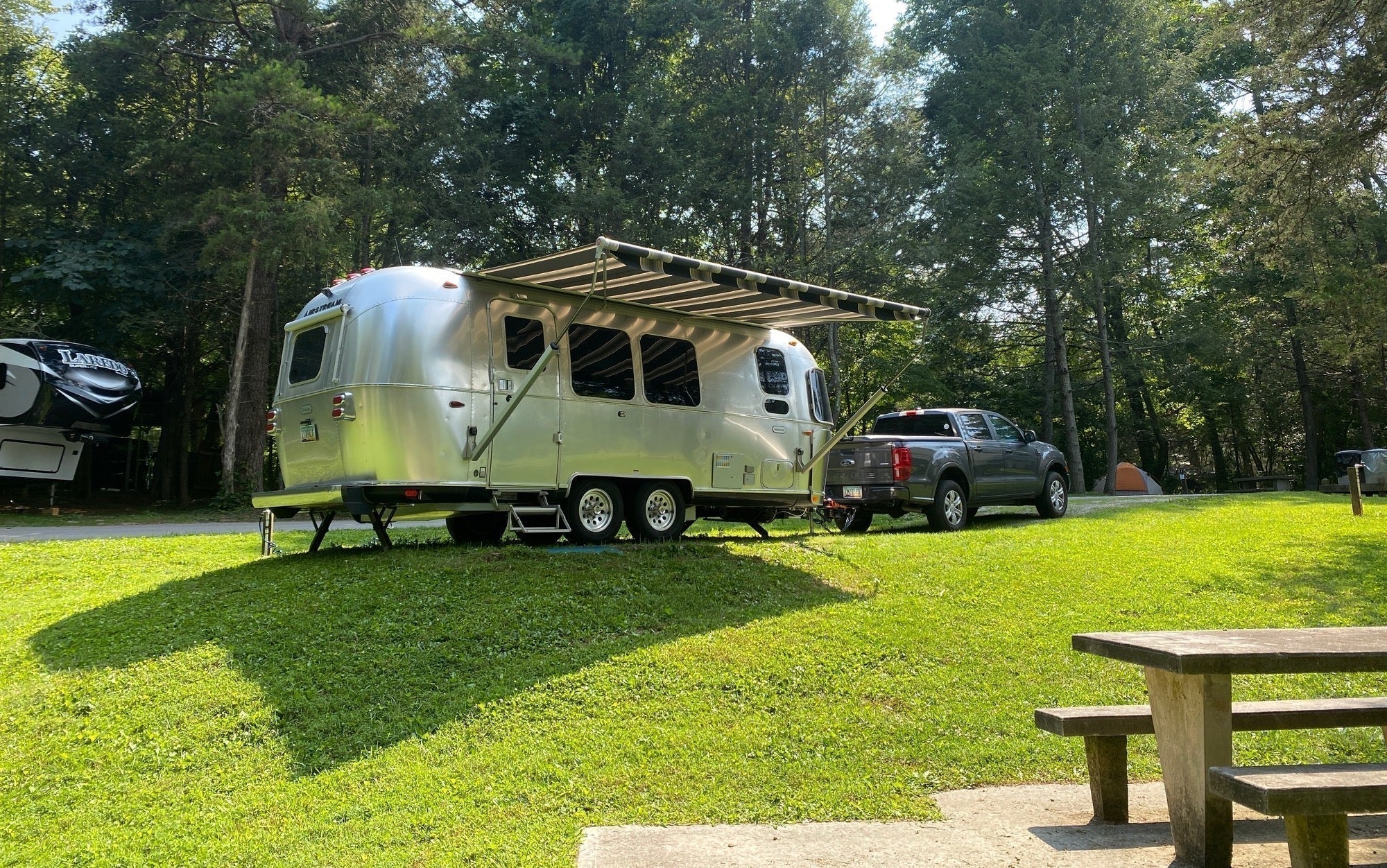
The awning that came with your Airstream can make a big difference if it's on the south or west side when you park. Definitely deploy the awning as much as you can to shade that side of the rig. If you've got window awnings, deploy those too as needed to cut the direct sun.
If you have an aluminum trailer with a Zip Dee awning, an AIR GEAR Sun Shade is a huge help, when the sun is beating down on that side of the trailer. This is especially true when the entry door is facing south or west.
We designed this shade with fabric that cuts up to 85% of the sun's heat, giving you a shady, private patch to enjoy in the afternoon. We use ours extensively and it really makes a difference.

5. Make sure your drinking water hose is safe for hot water
When camping in the heat you'll probably discover that you don't need to turn on the water heater. Often the fresh water hose lying in the sun, combined with warm water in the tank, will be plenty warm for showers.
But beware: most drinking water hoses are not rated for "hot water" use. Cheap-o hoses made of vinyl or other plastics may leach chemicals when laying in the sun all day filled with hot water. That's why our RV Water hose is rated for hot water use.
6. Monitor the fridge and freezer
Ever notice that the refrigerator doesn't cool down when it's really hot outside?
RV refrigerators don't always have great ventilation, so heat can build up in the refrigerator compartment (the space behind the refrigerator). When the air temperature around the refrigerator's cooling fins approaches 100 degrees—which is very common in the enclosed compartment, even when the outside temp is much lower— the result is warm food in the refrigerator.
Here a few ways you can mitigate this:
- Keep the fridge door closed as much as possible. When you need to retrieve something, get it out and shut the door as fast as possible. Unlike a home refrigerator that has a big compressor and can recover its coolness in a few minutes, an RV refrigerator can take hours to fully recover its chill on a hot day.
- If your refrigerator has a manually activated cooling fan, switch it on whenever the temperatures exceed 90. Some refrigerators have automatic cooling fans, others don't have fans at all.
- If yours lacks a fan, consider having a set of electric fans installed in the chimney of the refrigerator compartment. These things are amazingly effective at moving hot air out away and helping the refrigerator cool down.
- Get a wireless temperature monitor to check the interior temp without opening the door. These monitors are cheap and available from many sources. You could buy one for the freezer as well, but I'll tell you right now that if the fridge starts to climb above 50 degrees, whatever is on the door of the freezer will probably start to defrost.
- Pack your ice cream and seafood in the back. This keeps them away from the door, where the temperature fluctuates a lot more.
7. Prepare for the unexpected
Not many people will choose to spend a night in extreme heat or humidity without air conditioning, but someday you may find yourself in an unexpected situation where you must. A few summers ago, this happened to us at the no-hookup campground at Devil's Tower National Monument. It can also happen if there's a power outage in the campground or failure of the air conditioner.
In this case, the keys to surviving a night in the heat are water and electricity:
Water, because you need to stay hydrated and a quick cool shower will go a long way toward keeping your body comfortable. In desert boondocking situations you can even soak towels and place them strategically around the trailer for evaporative cooling. I suggest traveling with several gallons of extra drinking water when heading into a boondocking site in the summer.
Electricity, because you'll use a lot more battery power than usual with the vent fans running constantly. A single Fantastic Vent (the kind installed as original equipment in most Airstreams) might draw about an amp of power, which isn't much for short durations.
But with two of those fans running around the clock for a weekend, you're going to kill the typical 2-battery setup in an Airstream trailer (and that's before counting the needs of an electric refrigerator). You'll need to plug in, or have an auxiliary source of power: solar panels, portable power station, and/or a much larger set of batteries.
8. Don't leave pets in your RV during extreme heat
If you're expecting high heat during the day, be cautious about trusting the air conditioning and the campground's power. It's possible for brownouts or power spikes to knock your air conditioning off, and in full sun your Airstream can quickly reach dangerous temperatures.
We use the Micro-Air EasyTouch RV Thermostat to monitor the temperatures inside our Airstream when we are away. This thermostat connects to a WiFi hotspot – which for us is a Starlink Mini – and it's a great solution for monitoring and adjusting the inside temperatures during most months during the year. However, when temperatures are extreme, and we aren't parked in the shade, we always take our little dog Mickey with us when we leave the rig.
14 comments
Rich Luhr
Jeffrey C: It would be a bad idea to seal up the roof vent for a refrigerator. The fridge depends on the “chimney effect” to encourage hot air to flow up and out. Holes in the cabinets would release hot air into the living space (which would be counterproductive).
Boost fans are a custom modification, so you might be best off to look at small fans used for cooling electronics, and consult an RV technician to work out how best to mount them in the chimney.
Jeffrey Curtis
Our 23’ International has the roof vented fridge compartment and the fridge won’t get below 50 degrees or more on hot days when that side is facing the sun. We picked up an Iceco 12-volt fridge/freezer (in aluminum of course) to keep foods cold. Anyone ever tried sealing up the roof vent and drilling holes in the cabinets to let the fridge compartment vent to the inside of the trailer? Can you provide more information on the fan option? Thanks!
Rich Luhr
Randy - we don’t have weather apps to recommend specifically (there are too many to evaluate) but we do monitor the weather radar as we travel in the summer anywhere, especially in the midwest during tornado season.
Storm shelters are not common in campgrounds. But there are other places you can go, in a pinch. We always scout out a safe place as soon as we arrive at the campground. Often this is a brick or concrete block campground bathroom.
I’ll write a new blog about this subject soon. Thanks for the idea.
Randy Gates
Great article! We are based in Tucson as well and are heading to the mountains in a couple of weeks to get a break from the heat. You mentioned heading to the Midwest for your escape. We are planning one of those as well. I’m interested in how you dealt with, or prepared to deal with, the weather they are prone to this time of year. Are storm shelters a feature of most RV parks? Do you recommend any of the RV specific weather apps? Safe travels.
Lori Grassi
This is an excellent article as camping season has kicked off our summers are getting warmer. Happy to know we have most all of the items you mention in your article! Your thoughtful reminders are fabulous. Thank you!
Cheryl Toth
Kerry – Yes, we do recommend a soft starter and we sell the Micro-Air SoftStarter Breeze. You can learn more here: https://www.airgear.store/products/micro-air-easy-breeze-soft-starter
Anonymous
Kerry F: [UPDATED REPLY] Since we first published this blog, we have tested the Micro-Air EasyStart “Breeze” soft starter, and we love it. We have been able to run our 13.5k BTU air conditioner on a single 2,000 watt generator without problems, so now we recommend and carry that product in our store.
Note that the performance of a generator declines with higher altitude. Our tests have largely been at 1,000 feet altitude and lower. Also, a 15k BTU air conditioner may require a 2,200 watt generator even with an EasyStart installed. There’s more information about this on the EasyStart product page in our store.
Jeffery Hammonds
Our tip for hot summertime Airstreaming is to spend the summer in the Upper Pennunislia. At this moment (12:40) in Marquette, Michigan, the temperature is 73 degrees. Last evening was 57 degrees. (-:
Jude
Enjoyed the 8 tips article regarding the oppressive heat. Have friends who are not owners of an Airstream but to have a motor home. Going to pass this on to them, they are traveling all over the country for the next several months. Nice to see the articles coming while you are out of the country. KEEP THEM COMING.
Jude
Bob Grimes
If you have the wind deflectors (don’t know what else to call ‘em) over your fantastic vent fans, consider leaving these open while you are in transit. I find the trailer not to be as hot and stuffy when they have been open.
Anonymous
David, you don’t need to remove air during travel. The tire pressure (measured in PSI, not degrees) will naturally go up as the tires get warm during the day. The tire manufacturer has accounted for this, which is why they specify a recommended pressure “COLD”. It’s expected that the tire pressure will go up somewhat during travel.
By removing air when the tires were hot, they might now be too low in the morning when they are cold. You should check the pressure when the tires are cold, and add air to get them to the recommended pressure.
David Sundstrom
Driving home last Friday from camping near Austin TX in 95+ degrees F heat. My tire pressure monitoring system was telling me that the pressure in all 4 of my tires was 86°. I had made sure that they were at 80° when we left. I stopped and let pressure down to 80 degrees. Is this something I needed to do. I worry a lot.
David Gentry
Soft Start is a good option to have regardless of your genset size. It reduces the inrush current that occurs when the compressor turns on. I use a Champion 2500 Dual Fuel Inverter generator with a 13,500btu air conditioner. The weight is less than 50 lbs. vs the 100lbs of a 3500 watt unit. If I ever want to increase my capacity I will add another identical unit with a paralleling option. The dual fuel allows me to use propane and not carry gasoline. There are things to consider in order to allow the AC to work. If I have been boondocking and my batteries are low they will also put about a 5 amp (2 BattleBorn 100ah Lithium) load on my generator for charging and that will not allow the generator to hold voltage. (AC is 11 amps running and the additional 5 amps exceeds the total amp output of the 2500 at around 14-15 amps). So the genset can be used to recharge the batteries, and a lot of other loads, or run your AC.
Kerry Frank
Great blog post as always Rich! Question: for running the A/C on a generator, I ‘ve been reading about a soft start kit. Is this something you’d recommend?