
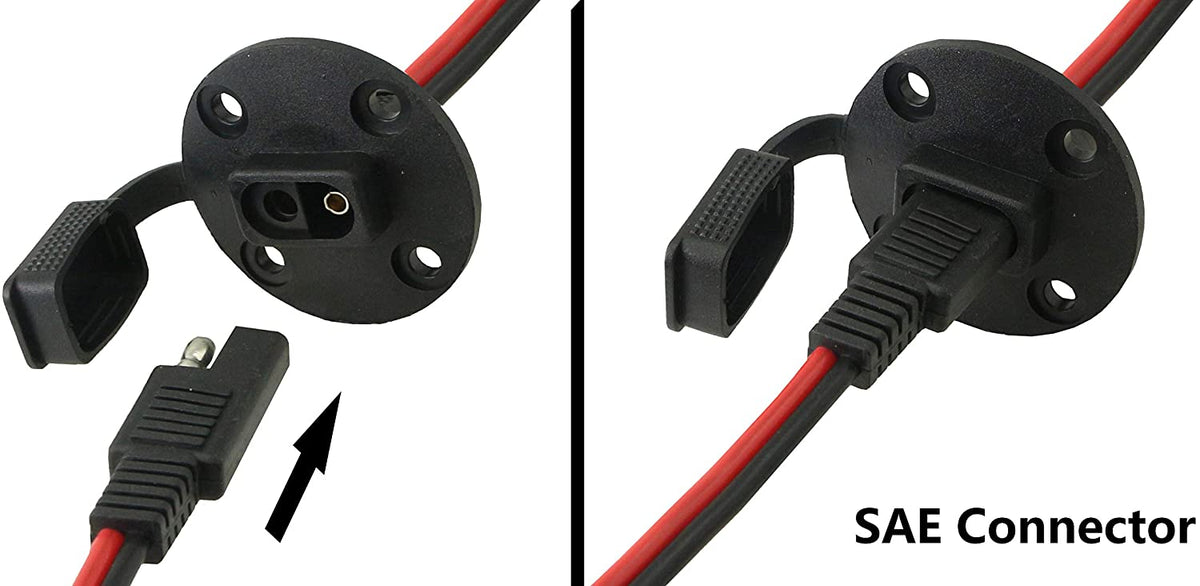
There's a myth that's been roaming around the Internet for many years. As the story goes, you can't plug a solar panel into the solar port of an Airstream without using some sort of adapter, because "Zamp made Airstream install a reverse polarity port."
This is nonsense.
But unlike a lot of other rumors which eventually fade away, this one has stubbornly remained in place. Hardly a month goes by when we don't get a question from a customer, who was told by an AI that they need to take extra steps to connect a portable solar panel to their Airstream.
I have refuted this myth many times since we first started selling portable solar panels in 2016, yet it continues to be repeated in forums, on social media, and even by some RV technicians.
So, when a customer wrote us last week with this question, I decided to write this blog. Although it may prove futile, it's an attempt to finally set the record straight. Will it work? Time will tell.
First, it's not a "Zamp" solar port
The solar port is actually a standardized 2-pin connector, designed by the Society of Automotive Engineers, which is why it is usually called a "SAE Connector" or "SAE Solar Port."
The confusion comes from the fact that many RV brands had stickers applied on the factory-installed solar port that said "USE ONLY ZAMP PANELS." Lots of Airstreams prior to 2020 had that sticker because Zamp was supplying the SAE Solar Port to Airstream at that time.
But the sticker was just good marketing. Zamp wanted to promote their brand and the sticker was a good way to do it.
I've also heard rumors that the "Zamp port" is deeper or has a minor tweak that makes it only fit other Zamp plugs. This is also not true. Every standard SAE plug we've ever used has fit perfectly into every solar port installed on every brand of RV owned by our customers.
Over the years, Airstream has moved beyond the Zamp brand and now installs versions of the SAE connector that are made by other manufacturers.
But regardless of the brand, it's still a standard SAE connector, and SAE connectors are all the same.
There's no official standard for wiring polarity
The SAE Solar Port on an Airstream is typically wired as shown in the image below:

But currently, there's no industry standard across all possible uses–cars, trucks, solar panels, batteries, etc.–for how to do this. That means this port can be wired with positive on either terminal. So the claim that it could be wired "in reverse" is non-sensical. Reverse of what?
What does matter is that the output plug from your solar panel charge controller matches the polarity of the input port you're connecting it to. If you buy a portable solar panel kit from AIR GEAR, the polarity will be correct "out of the box." In other words, it will work without any modification.
"Reversed polarity" is easily corrected
If you plug a solar charge controller into the solar port on your RV (regardless of brand) and there's no power to start the controller–meaning that the charge controller's indicator lights don't go on–don't panic, but you might have a polarity issue.
Why does this happen? Well, often it's because some well-meaning RV technician has swapped the wires. Believe it or not, we see this regularly, because even professionals get sucked in by the "reversed polarity" myth, and so they "fix" it for you.
Reversing it back is simple: buy an inexpensive SAE polarity reversing plug. You can find them all over Amazon for a few dollars.
Listen to a voltmeter, not an AI chatbot
Save yourself some trouble. Before asking an AI (or a confidently wrong person on social media) and assuming your Airstream has "reversed polarity," get the facts by testing it yourself.
You can do this with a simple voltmeter, available in hardware stores and online. This help article explains how, in the section titled, Check voltage at the solar port. Armed with the facts, you can then take the appropriate next step.
Please do your part!
The next time you hear the "reversed polarity" myth being spread at a rally or in a social media group, I hope you'll share the information or a link to this article. Let's bust this one together so newbies and all RVers get accurate information instead of repeating old stories.
7 comments
Steven Smith
Patrick! A solar controller is ALWAYS needed! There might be one already installed on your trailer, but check to be sure. If it was a Victron unit, installed by Airstream, make sure it is sized for your panels, and the settings fit your batteries,
Rich Luhr
Patrick Myers: No — absolutely not! You always need a charge controller when connecting solar panels to the SAE Solar Port (unless the port has been modified to go through a charge controller in the trailer, but this is not the factory setup). Don’t connect solar panels to the charge port without a controller, or you risk a dangerous situation with the batteries.
The polarity discussion is about whether the charge controller for the solar panels will power up and operate. With incorrect polarity, it won’t, and so the solar panels won’t be able to do anything. The polarity of the SAE port must match what the charge controller needs.
John Nametz
My guess is that the confusion comes from how many of the SAE plugs are wired. If they are meant to be connected to a 12v battery for connecting heated vests etc, then they will have the shielded plug end on the red (positive) battery wire.
Airstream chose to put both SAE ends in a protected insert area. The bare plug end is positive as you have shown (thankyou) which is reverse of many motorcycle and atv SAE plug battery connectors. The SAE plug I found and wired to a 30 volt converter for Starlink was such an SAE plug. I had to reverse the wires to be: red is neg and black is pos. In order to connect to my 25’ airstream solar port to power the Starlink. The Mini works great!
John
I’ll admit to being flummoxed by this. We pulled the batteries out of our Airstream at one point for long-term storage and I never re-connected the solar port because I wasn’t sure “which way” to do it. Now I know the positive terminal on the connector (per your photo above) goes to the positive terminals on the battery (unless my volt meter says otherwise). Full stop. Thank you.
Patrick Myers
So, in other words, if the volt meter shows the polarity is correct, you can just plug the solar panel right into the port and not use a solar controller, is that what you’re saying?
Raymond Russell
Great article! Thanks for clearing up the urban legend. I’m going to break out my voltmeter and check our SAE connection.
William Colwell
AI
Stupid is as stupid does